after moksha of chandra grahana (end of lunar eclipse phenomenon), i had sometime to spare before my daily Sandhya Vandhana etc. listening to my favourite hindu classical songs this morning. i could go on a highly ecstatic spiritual journey led by renowned classical singers such as k j jesudas and sudha raghunathan and bhajan exponents such as vittaldas and anup jalota. thanks to my notebook and datacard.
16 June 2011
14 June 2011
Off the beaten track: At Crosswords (Bookshop)
this evening after office, i had enough time to visit `crosswords', my favourite bookshop and buy `dancing in cambodia and other essays' by the acclaimed writer amitav ghosh. though before buying any book, i usually read as many reviews as possible or atleast preview the contents at random, i couldn't do the excercise for this book. but still, the book attracted my attention. as someone who lived in phnom penh for a year, i was interested in knowing how amitav ghosh perceived the country and its people. hope the book is interesting.
15 May 2011
Off the beaten track: Customer satisfaction
It is a common belief that private companies are better than public sector undertakings.
A few years back, soon after buying a fully automatic washing machine for our house, I found the filter giving frequent problems, despite regular cleaning. Recently, soon after buying a brand new split AC with some advance features for our house, I came to know that there was a fault in the unit.
What makes a company customer friendly is the attitude of the customer support staff in the company more than anything else.
01 May 2011
Canned fruit juice and concrete concepts
As we all know, canned fruit juice is a popular consumer item today. Just like most other household items, fruit juice cans can be used very effectively in teaching a range of K-8 mathematics and science concepts.

When I was a teacher, I used to get throw away cans collected by my students so that they can use them when learning lessons.
Usually, our textbooks explain concepts such as `Moment (Turning effect) of a force' in a didactic manner (which I hated when learning science at school). If you go through our textbooks at random, you may find that they do not attempt to present the application component of concepts in children's real life experiences.
When we present questions such as "Look at the can. We can open it simply by using our finger. Is it possible to open it more easily?" and give enough `wait time' (a crucially important factor, which is often ignored in classroom settings), some children will certainly come up with ideas such as "We can open the can more easily by using a stick".
This can pave way for deeper learning of the mathematical aspect (Moment = Effort X Effort arm) or the mechanical aspect (Moment can be increased by increasing the distance of the point of application of force from the pivot).
This can pave way for deeper learning of the mathematical aspect (Moment = Effort X Effort arm) or the mechanical aspect (Moment can be increased by increasing the distance of the point of application of force from the pivot).
Chances of children's ability to come up with such suggestions are greater when we provide them with relevant material resources (for instance, a few sticks in the above mentioned example).
When we couldn't even get fruit juice cans, my students never despaired; they learnt the concept by using doors and doorknobs; they made comparisons when the effort arm changed; they developed graphs by using pencil and paper (decades before "Excel" and "Insert Chart").
I don't think that our Syllabus Boards or Examination Boards stand in our way when it comes to implementing innovative approaches using child friendly materials within K-8.
23 April 2011
Household items, activities and games in K-10 Mathematics and Science Education
In my post on April 18, I mentioned the importance of outdoor games to children. I am sure that you would agree with my point of view.
When we were children, we used to go out in the evenings and play simple games such as hide and seek. During summer, when the whether was very hot, we used to get ourseves involved in hobbies such as making cardboard houses. Later, I had the pleasure of involving my science and mathematics teaching colleagues in such activites so that the pedagogic benefits and the pleasure derived could be passed on to children. Most of my colleagues, students and their parents liked the idea.
When we were children, we used to go out in the evenings and play simple games such as hide and seek. During summer, when the whether was very hot, we used to get ourseves involved in hobbies such as making cardboard houses. Later, I had the pleasure of involving my science and mathematics teaching colleagues in such activites so that the pedagogic benefits and the pleasure derived could be passed on to children. Most of my colleagues, students and their parents liked the idea.
There are numerous ways in which simple household items with which children are familiar, can be used to teach lesson concepts. My students and teacher colleagues in different countries have enjoyed `playing' with coffee and fruit juice containers as shown below, when handling concepts such as area and volume:
 Infact, even concepts such as linear equations (in middle school algebra) can be taught very effectively by using pupil friendly playway approaches.

If you closely observe teaching learning processes in our K-10 schools here in India, you can find that activity based approaches take a back seat. The most common reason attributed to this odd state is that our Syllabus and Examination Boards are highly quantity oriented at the cost of quality.
Yes, it is true, at the 9-12 level where Public Exam marks matter a lot. At the same time, neither our Syllabus Boards nor Exam Boards are bottle necks when it comes to using innovative and activity based approaches in K-8 classrooms. But still, many schools are reluctant to introduce these approaches because of false notion about syllabus and exam requirements and because our K-8 textbooks don't contain as much learner friendly activity based contents as they should.
Hope our textbook publishers, at least at the K-8 level, break away from their current inertia and include innovative activity based learner friendly contents. Many K-8 Mathematics and Physical Science lesson concepts can be taught effectively by using teacher and pupil friendly activities in the classroom and enabling them to be used in homework assignments.
As UNESCO stated in one of its reports, most K-10 science concepts can be taught effectively using household items.
Yes, it is true, at the 9-12 level where Public Exam marks matter a lot. At the same time, neither our Syllabus Boards nor Exam Boards are bottle necks when it comes to using innovative and activity based approaches in K-8 classrooms. But still, many schools are reluctant to introduce these approaches because of false notion about syllabus and exam requirements and because our K-8 textbooks don't contain as much learner friendly activity based contents as they should.
Hope our textbook publishers, at least at the K-8 level, break away from their current inertia and include innovative activity based learner friendly contents. Many K-8 Mathematics and Physical Science lesson concepts can be taught effectively by using teacher and pupil friendly activities in the classroom and enabling them to be used in homework assignments.
As UNESCO stated in one of its reports, most K-10 science concepts can be taught effectively using household items.
22 April 2011
Off the beaten track: Zodiac The Shirt People
When I was glancing through the pages of this morning's edition of Times of India, I was delighted to see a full page ad released by the manufacturers of `Zodiac', one of the first branded shirts in the Indian market. [Ofcourse, even in the '60s, there were a few other very good shirt stores such as `Chellarams' in Madras. Chellarams was my favourite store and my dad used to take me there whenever we used to go to Madras. The last time when I bought Chellarams shirts was in 1978, when my parents went to Madras to buy dress materials, utensils and other items which were needed for my sister's wedding].
This morning's ad reminded me of 1985-1986, when I was teaching at a school in Cochin (now known as Kochi). I used to have my monthly shopping at Zodiac showroom in Abad Plaza in M G Road, Ernakulam. Though the shirts were relatively expensive, their qualty mattered a lot to me. Besides, the store had a tailoring section which helped in minor alterations such as the length, to suit individual needs. I was also a member of the Zodiac Club. Members used to get their 13th shirt free of cost.
When talking about trousers, I always used to get them stitched for the simple reason that readymade ones never fitted my size (I am thin built). I used to get my trousers stitched at `Rajan tailors', in Thorappadi, Vellore, where we had settled for more than 30 years. This tailoring shop was smaller than many tailoring shops in the town and the charges were very moderate. I have never come across trousers stitched as perfectly as at Rajans, anywhere else. This shop was a classic example to disprove our common belief that quality is related to price tag. The photo of mine shown below is a clear proof of how fitting were the trousers stiched by them (This picture was taken in late '80s when I was teaching in Southern Africa).
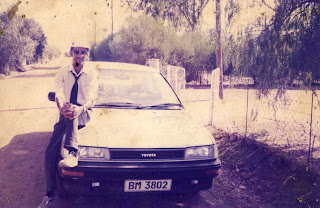
 My shirt was bought during a shopping spree in Harare, Zimbawe, on route Victoria Falls during holidays, thanks to to my Toyota Corolla 1.3L, which was one of my companions as illustrated in the following photograph; the photograph was taken during lunch break in front of my flat in the teachers' quarters inside the campus of the school were I taught:
[Since moving to Madras, I have been shopping at `Peter England' and `Raymonds' for my shirts and trousers respectively. While the former is very satisfying, the latter is not, at times].


[Since moving to Madras, I have been shopping at `Peter England' and `Raymonds' for my shirts and trousers respectively. While the former is very satisfying, the latter is not, at times].
19 April 2011
Whenever I travel, I take my notebook and datacard with me, so that I can watch my favourite TV programmes (some of which may not be available in the conventional TV at the venue where I stay).
Recently I derived the joy of listening to the melodious voice of Sri Shashidhara Kote and the spiritually enlightening explanation by Sri Gururaj Karajagi, in their programme `Daasa Vani' on Sri Sankara TV. This program centers round the spiritual compositions of saints such as Purandaradasa about Shri Hari and His great devotees.
Thanks to the `world wide web' for enabling people like me to quench our spiritual thirst, even when travelling.
Thanks to the `world wide web' for enabling people like me to quench our spiritual thirst, even when travelling.
18 April 2011
Outdoor games and computer/videogames for children
People of my age know very well as to the immense benefits which children can derive by playing outdoor games.
Today, most of our towns and cities do not have adequate space for outdoor activities at all. Children seem to be addicted to TV (watching counter educative programmes) or to computer and video games. Very often, parents seem to encourage such trends.
I am not saying that virtual games are useless. What I do mean is that such games are cognitively benefitial in lesson concept development (particularly in subjects such as high school physics as I have myself seen) only if they are used with well defined educational aims and objectives. This fact is endorsed by research studies.
From the health point of view, outdoor games are certainly far more superior, for obvious reasons. I think that our schools should encourage outdoor games which all children can play.
What do you think?
09 April 2011
Stories in school textbooks
Good stories have always been an effective teaching resource in classrooms. Our textbooks need to contain as many good stories as possible.
Though I have used stories in my own teaching, it was not until I began working in `Chandamama' (a children's magazine from Chennai) for a few months, that I ever thought of writing one. One of my career responsibilities at Chandamama was to write short stories in English, which would then be translated by someone else, for publication in the children's section of `Dainik Bhaskar', a Hindi language periodical published in Northern part of India.
Though I have used stories in my own teaching, it was not until I began working in `Chandamama' (a children's magazine from Chennai) for a few months, that I ever thought of writing one. One of my career responsibilities at Chandamama was to write short stories in English, which would then be translated by someone else, for publication in the children's section of `Dainik Bhaskar', a Hindi language periodical published in Northern part of India.
One of my short stories is as follows:
Biju’s back pain
It’s Sunday evening. Biju spent the whole day out with his friends and forgot all about Monday’s English test at school. He returns home after play and takes a fresh bath. It’s 8 o’ clock. His mother says, “Biju, dinner is ready. Don’t waste your time. You have to prepare for tomorrow’s English test.’ This worries him.
Well, what does Biju like to do at school? Sometimes, he finds it so interesting to watch what’s happening outside the window that he completely misses the teacher’s lessons and all those important points that she writes on the board.
It is 8.15. Biju sits at the dining table. His plate contains vegetable soup, yoghurt and a few fruits. He usually relishes them. But now, they look like monsters saying, “Hey, tomorrow morning Ms Sen will be in your class with her question paper. How are you going to handle it?” This terrifies him. He has to act swiftly before it is too late. Within a few minutes of no nonsense planning, he gets the idea!
As he eats his dinner, he groans frequently. His parents get anxious and ask as to what is wrong with him. He groaningly replies, “Oh, my hands and back are paining so much that I cannot even lift the water bottle”! His dad says, “Biju, that’s what happens when you play the whole day. Any way, it doesn’t matter. You can stay away from school tomorrow and take rest”. This is exactly what Biju expected, after all! He is happy that the ordeal has ended.
He spends the next day without watching much TV. He is both sorry and happy. In the evening he phones Nelson, his classmate, to find out about the test. Nelson says, “There was an unexpected change in the class time table this morning. There was a magic show. Hence Ms Sen said that today’s test is postponed for tomorrow and will contain more questions to answer”. Biju almost `faints'.
Moral: Don’t cheat.
04 April 2011
Off the beaten track: World cup cricket
It was nice to watch India winning the world cup after 28 years. We have had internationally acclaimed sports persons in games such as lawn tennis, chess and athletics. It will be nice if the abovmentioned games as well as games such as hockey, football, long jump and table tennis are also given importance, besides cricket. Many of these games are very cost effective and can easily be promoted in our schools and colleges.
Subscribe to:
Posts (Atom)
About Me

- Guruprasad Panamalai
- Kumbakonam , Tamilnadu, India
- I am a retired K-12 Education Management Professional. I have worked at different levels in K-12 school systems, textbook publishing, elearning and Education NGOs. I have held memberships in The Association for Science Education (UK), American Association of Physics Teachers and The Malaysian Institute of Physics. I hold a 1st class B Sc Degree in Physics followed by B Ed [English and Physical Science] and M A [Childcare and Education] degrees. My published works include 59 articles in teacher development magazines in India and the US and a book entitled `Creative Classrooms and Child Friendly Schools' (listed in Amazon). This book is almost an anecdotal account of my professional experience in six countries (including Cambodia where I worked as Technical Adviser to the Ministry of Education, Youth And Sports). I served as mentor in the Certificate of Teaching Mastery Program offered by Teachers Without Borders.