07 September 2011

Encouraging sports in our schools

Two news items in this morning's newspaper caught my attention. The first one about India's defeating South Korea in the Asian Trophy match and the other one about Ms Jayalalitha's announcement of a proposed Centre of Excellence in Sports for school students in the 10-14 age range.

I remember my own school days, nearly 5 decades back, when school children used to play football, khabhadi, etc. in addition to cricket.

My father was a great sportsman during his college days. He used to tell us about the importance of sports. He insisted that I join the then ACC (Auxiliary Cadet Corps), which I did. ACC was an integral part of the school sports curriculum in those days. As a popular headmaster he used to get `District sports' organised in whichever school he worked.

My father (seen at extreme right in the photo) supervising some children running `sack' race in his school
It was a pleasure for us to spend three full days in the school playground and watching children from different schools perform.

Later when I was in college, I used to  play cricket. Whenever I batted, there used to be runner who used to run for me, as I could not run fast due to my polio in the right leg. However, I was popular as a left arm spinner. Table tennis and chess were two  other games in which I used to actively participate. 

My father, known to be a man of high self-esteem, continued playing lawn tennis regularly until he was 65. As he used to say, my mother was of great support to him in all his achievements.

When I worked as a school principal, I had always encouraged children, particularly girls and those from poor parental backgrounds to  excel in academics as well as in sports. I had always insisted that girls should be coached only by female teachers, for obvious reasons.

I had the pleasure of motivating my collegues into playing the above mentioned games as well as intellectually stimulating games such as SCRABBLES. Pleasure of playing good games had a cascading effect and fostered team spirit.

I think that our K-12 high schools can be centres of excellence in sports if school managements have the will and principals have parental passion.

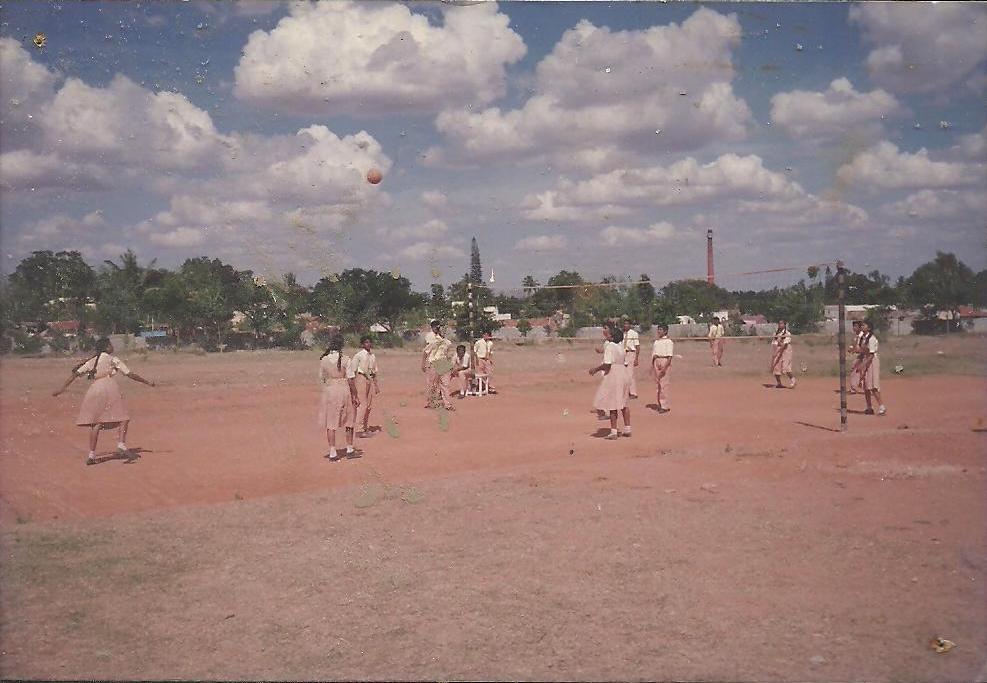
Let me end this post by posting a few photographs to illustrate how my students enjoyed games and sports when I worked at Poorna Prajna High School in Yelahanka,  Bangalore, in 1997.


02 September 2011

Teacher - student relationship

Today seemed to be just another day in the calender as I was checking my emails: inboxes flooded with junkmails and invitations from social networking vultures, which I promptly delete, as soon as I see them in the list. This time it was a bit different. There was an invitation from a young lady from facebook. I accepted her invitation as she seemed to be my student in late '90s.

I and my students liked each other. It had always been easy for me to treat my students somewhat like a parent would. I cherish my students' affection as reflected in (i) one of the poems written by my students at a high school in Bangalore in 1997 and (ii) a short write up written by a student in the 30th Anniversary Souvenir published at a secondary school in Southern Africa in 1988, as shown below:


It is the moral obligation of teachers not to let children down for any reason. For example, if children's language skills are poor, instead of giving discouraging comments, teachers should allow them to continue speaking (or writing) and then guide them properly. I cherish mementos given by my students whenever I resigned from  my post in any school. These mementos tell a lot about student - teacher relationship. One such memento given to me by a group of children on a working day before or after Vinaayaka Chathurthi, when I resigned from my post a school in Avadi, Chennai, is shown below:


I think that a teacher's role begins when he or she interacts with children like a parent. A school principal's role begins when she or he interacts with young colleagues like a parent and with older colleagues like a sibling. When this happens, children will be happy and so will the parents.

Children enjoying their post lunch free time at the school in Bangalore
An article which I read just an hour back, reflects my own viewpoint as to what it means to be a good teacher.

Off the beaten track: Decaying cultural values

This morning I had some time to read a newsletter from a Hindu Organisation based in Trinidad. It contains a very meaningful poem written by someone in Trinidad, located tens of thousands of kilometers from India. The poem echoes thoughts of many of us, who wish that our youngsters do not lose grip of our cultural heritage. [Though the decay of cultural values is very obvious in today's younger generation, I think that the process already began a few decades back, when heavy metal rock music and odd movies entered the consumerist platform with the result that youngsters could not draw a fine line between modernity and lack of cultural values. I myself liked western popmusic and movies but my interest was confined to soft rock music with good lyrics and non-obscene classical films].

Our schools have a crucial role to play in this direction, in today's circumstance where parents (both mother and father) are busy in fulfilling material needs (which are often unreasonably large).


26 August 2011

Off the beaten track: Chaotic commercials

As I don't own a TV in Gujarat (I don't have much time to watch TV), it is a welcome change for me to watch good programmes (spiritual and classical) on TV back home. It's great that such programmes are aired.

Coming to TV commercials, I don't really understand as to the relevance of high speed commercials as a viable marketing strategy. Today, in BBC World, there was a commercial from a datacard manufacturing company.  The commercial goes like this: a lady gets caught in a fire accident and self-drives her car very speedily to the nearest fire station at which time she also communicates using a datacard. However, I didn't see her operating her computer keyboard (or mouse) at any point in the clipping. Assuming that she did work on her keyboard or mouse, I wonder as to how she can `multi-task' so efficiently in such a situation.

Any how, as I myself use the above mentioned product for the past one year, I am convinced that it is a quality product.

25 August 2011

Off the beaten track: Timely taxi to troublesome trolley

Yesterday, I flew home on a few days' leave from my work in Gujarat. Like in past January, this time  too it was a pleasant travel from Vadodara to Ahmedabad airport, thanks to Manojbhai, the call taxi  operator for timely service, and from there to Madras, thanks to cordial staff of Indigo Airlines at Ahmedabad and on board the flight.

Three airhostesses who were checking our boarding passes, greeting passengers on entering the plane and expressing thanks when we were leaving the plane at the end of our flight, displayed impressively good manners. When my turn came, I could hear them adding `Sir' after greeting and thanking respectively. Even if they had done their `duty' without addressing me with respect, they would not have had anything to lose. But still, they carried out their responsibility beyond the normal `duty' level. I think that these youngsters inherit such good values from their parents and grandparents. Hope this tradition continues.

The only problem which I faced surfaced at Madras airport, where the trolleys work only when their handles are pushed down (which translated into an overnight long pain in the arm). It would be better if the airport authorities replace the trolleys so that non-athletic passengers like me can be pain free.


16 June 2011

Off the beaten track

after moksha of chandra grahana (end of lunar eclipse phenomenon), i had sometime to spare before my daily Sandhya Vandhana etc. listening to my favourite hindu classical songs this morning. i could go on a highly ecstatic spiritual journey led by renowned classical singers such as k j jesudas and sudha raghunathan and bhajan exponents such as vittaldas and anup jalota. thanks to my notebook and datacard.

14 June 2011

Off the beaten track: At Crosswords (Bookshop)

this evening after office, i had enough time to visit `crosswords', my favourite bookshop and buy `dancing in cambodia and other essays' by the acclaimed writer amitav ghosh. though before buying any book, i usually read as many reviews as possible or atleast preview the contents at random, i couldn't do the excercise for this book. but still, the book attracted my attention.  as someone who lived in phnom penh for a year, i was interested in knowing how amitav ghosh perceived the country and its people. hope the book is interesting.   

15 May 2011

Off the beaten track: Customer satisfaction

It is a common belief that private companies are better than public sector undertakings. 

A few years back, soon after buying a fully automatic washing machine for our house, I found the filter giving frequent problems, despite regular cleaning. Recently, soon after buying a brand new split AC with some advance features for our house, I came to know that there was a fault in the unit.

What makes a company customer friendly is the attitude of the customer support staff in the company more than anything else.


01 May 2011

Canned fruit juice and concrete concepts

As we all know, canned fruit juice is a popular consumer item today. Just like most other household items, fruit juice cans can be used very effectively in teaching a range of K-8 mathematics and science concepts.

When I was a teacher, I used to get throw away cans collected by my students so that they can use them when learning lessons.

Usually, our textbooks explain concepts such as `Moment (Turning effect) of a force' in a didactic manner (which I hated when learning science at school).  If you go through our textbooks at random, you may find that they do not attempt to present the application component of concepts in children's real life experiences.

When we present questions such as "Look at the can.  We can open it simply by using our finger. Is it possible to open it more easily?" and give enough `wait time' (a crucially important factor, which is often ignored in classroom settings), some children will certainly come up with ideas such as "We can open the can more easily by using a stick".

This can pave way for deeper learning of the mathematical aspect (Moment = Effort X Effort arm) or the mechanical aspect (Moment can be increased by increasing the distance of the point of application of force from the pivot).

Chances of children's ability to come up with such suggestions are greater when we provide them with relevant material resources (for instance, a few sticks in the above mentioned example).

When we couldn't even get fruit juice cans, my students never despaired; they learnt the concept by using doors and doorknobs; they made comparisons when the effort arm changed; they developed graphs by using pencil and paper (decades before "Excel" and "Insert Chart").

I don't think that our Syllabus Boards or Examination Boards stand in our way when it comes to implementing innovative approaches using child friendly materials within K-8. 

23 April 2011

Household items, activities and games in K-10 Mathematics and Science Education

In my post on April 18, I mentioned the importance of outdoor games to children. I am sure that you would agree with my point of view.

When we were children, we used to go out in the evenings and play simple games such as hide and seek. During summer, when the whether was very hot, we used to get ourseves involved in hobbies such as making cardboard houses. Later, I had the pleasure of involving my science and mathematics teaching colleagues in such activites so that the pedagogic benefits and the pleasure derived could be passed on to children.  Most of my colleagues, students and their parents liked the idea.

There are numerous ways in which simple household items with which children are familiar, can be used to teach lesson concepts. My students and teacher colleagues in different countries have enjoyed `playing' with coffee and fruit juice containers as shown below, when handling concepts such as area and volume:

Infact, even concepts such as linear equations (in middle school algebra) can be taught very effectively by using pupil friendly playway approaches. 
    
If you closely observe teaching learning processes in our K-10 schools here in India, you can find that activity based approaches take a back seat. The most common reason attributed  to this odd state is that our Syllabus and Examination Boards are highly quantity oriented at the cost of quality.

Yes, it is true, at the 9-12 level where Public Exam marks matter a lot. At the same time, neither our Syllabus Boards nor Exam Boards are bottle necks when it comes to using innovative and activity based approaches in K-8 classrooms. But still, many schools are reluctant to introduce these approaches because of false notion about syllabus and exam requirements and because our K-8 textbooks don't contain as much learner friendly activity based contents as they should.

Hope our textbook publishers, at least at the K-8 level, break away from their current inertia and include innovative activity based learner friendly contents. Many K-8 Mathematics and Physical Science lesson concepts can be taught effectively by using teacher and pupil friendly activities in the classroom and enabling them to be used in homework assignments.

As UNESCO stated in one of its reports, most K-10 science concepts can be taught effectively using household items.


About Me

My photo
Kumbakonam , Tamilnadu, India
I am a retired K-12 Education Management Professional. I have worked at different levels in K-12 school systems, textbook publishing, elearning and Education NGOs. I have held memberships in The Association for Science Education (UK), American Association of Physics Teachers and The Malaysian Institute of Physics. I hold a 1st class B Sc Degree in Physics followed by B Ed [English and Physical Science] and M A [Childcare and Education] degrees. My published works include 59 articles in teacher development magazines in India and the US and a book entitled `Creative Classrooms and Child Friendly Schools' (listed in Amazon). This book is almost an anecdotal account of my professional experience in six countries (including Cambodia where I worked as Technical Adviser to the Ministry of Education, Youth And Sports). I served as mentor in the Certificate of Teaching Mastery Program offered by Teachers Without Borders.