13 October 2011

Off the beaten track: Druk kingdom's royal wedding

There is a country just neghbouring India in the north east. It is beautiful in terms of landscape, natural resources, nice people and national economy indicators such as Gross National Happiness. Its government takes careful steps in retaining the country's traditional values and in prevening many problems which we see in many developing countries including India.

Today, Jigme Khesar Namgyel Wangchuk, king of this beautiful country Bhutan, married Jetsun Pema, in a colourful ceremony in Phunakha, a regional town.


I remember pleasant times when I taught in schools in this beautiful Himalayan kingdom from 1978 to 1981 and then again in 1985. When I taught in a beautiful village known as Shaba, as the classes ended at 3 PM on all weekdays, afte lunch, I and my friends used to walk a few kilometres to Paro, the provincial town to collect our mails from the post office. I cannot describe the beautiful landscape through which we walked, in words. En route, we used to pass the plot which was later to become the first airport (Paro airport) in the Kingdom. Following photo shows me with a few colleauges and their children:

It is possible to know about this interesting country and its people to some extent from the country's Postal Department.  

Let me leave you with some melodious Bhutanese music.

Kadrinche la (Thank you).

10 October 2011

Off the beaten track: The Beatles

Yesterday was the death anniversary of John Lennon of the The Beatles. Like tens of thousands youngsters during the '60s and '70s, I was also attracted by their softrock music (though I didn't like lyrics of many of their songs). It was interesting to read about them (George Harrison's association with ISKCON and his meeting with Maharishi Mahesh Yogi, Paul McCartney's skill in handling his sitar after getting trained from Pandit Ravi Shankar, etc).

I used to be very interested in listening to softrock music and reading magazines such as LIFE and JUNIOR STATESMAN (popularly known as JS) for their articles on softrock bands. The Beatles were one of the most popular western softrock bands of that era.  One of their best songs was Get Back.

08 October 2011

World Teachers' Day: Teachers' status

Every year, 5 October is celebrated as World Teachers' Day (exactly a month after the day is celebrated in India).

In ancient India, teachers were a revered lot as they were role models for youngsters to emulate in the communities which they served for. But over the years, things changed, particularly in the past few decades.

People of my generation began our first day at school only when we were at least five years old. Our school began at 10 in the morning and ended at 4 in the afternoon. In general, our teachers were very strict but not harsh. Though we never had `mathematics laboratories' and `comprehensive evaluation' in our schools, moral education, arts and crafts (such as drawing, weaving etc), games and cultural activities were integral components of the school curriculum. There were inter-school competitions with positive aims and objectives. (I was considered to be excellent in elocution competitions in both English and Tamil during my student days. Being a strict headmaster of the high school where I studied, my father had always seen that I got the same treatment as all other students. Infact if my father happened to be one of the judges, he would see that he never gave highest ranking to me, though I would have been the top performer. It was not uncommon to see impartial teachers and headmasters in those days).    

In our high schools we had two main curricular streams: Academic and Bifurcated. Academic curriculum centred on typical curricular subjects whereas bifurcated curriculum included courses in typewriting etc. Students used to literally work with  typewriters, unlike in many schools today with no facilities for students to handle computers on an individual basis.

There were problems such as emphasis on rote learning (which remains to be so to this day though conspicuously) and drop-out rate. Many such problems were due to wrong policy making by politically driven bureaucrats, in spite of several education commissions. 

Teaching was a noble profession on 5 September (Teachers' Day in India) and the least respected profession on all other days. Teachers with university degrees drew less salary than other workers such as bank clerks who would have completed only upto secondary school final. Movies depicted teachers in a wrong stereotyped manner: An old male elementary school teacher borrowing money form someone or the bank to get his daughter/s married off and finding it difficult to repay his loan.

In the '80sand '90s, it was common in India for many teachers like me to seek teaching careers abroad. On 16 October 1981, I signed a contract with the Ministry of Education, Government of Ethiopia (officially known as 'Provisional Military Government of Socialist Ethiopia' at that time) alongwith many young teachers like me, to teach in schools in Ethiopia, after an interview held at Chennai (known as `Madras' then). At the time of interview I  asked the interview panel as to whether I could come to India during school summer holidays in order to get married and take my wife to Ethiopia. The panel members said that there was no problem.

I left for Ethiopia in January 1982. I was posted along with Sebastian Perunmcheril  John, a very nice guy from Kerala, to teach in a remote village known as Shire, Endaselassie in Tigrai region, of which Makelle is the capital town. Sebastian and I taught Chemistry and Physics respectively to Grades 11 and 12 in Shire Seconday School.  
Sebastian and I with a colleague's daugher who liked to be photographed with  us
Though telephonic communication was not possible from there, we could communicate with our parents in India using snailmail. The local post office marketed nice picture postcards with blank space for messages. Sebastian and I used these cards when communicating with our parents. Following picture shows a picture postcard which I used.
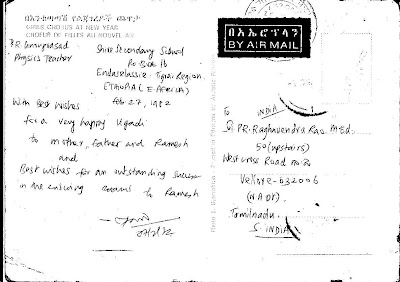
Picture postcard
Though Shire was a small village with just one Government Senior Secondary School, the people were very friendly. Mr Asafa, Director of the school, was a very nice man as were other colleagues. (I think that he had a degree in Economics and a degree in Education from the University of Addis Ababa).

With Assafa
As Shire was remote, Sebastian and I sought a transfer. I applied for transfer to Addis Ababa or any place near Addis Ababa, so that I could take my wife.

As soon as summer holdiays began, I was in Addis to follow up my application for transfer and to apply for my exit and re-entry visa. When I went to the education ministry to get my exit and re-entry visa processed, officials said that my application would be processed only  if I deposited 6 month's salary as  guarantee to the education ministry. This was not a small amount, for any teacher from India who  worked in Ethiopia at that time. I was shocked to hear this. I told the ministry that my marriage was getting fixed and that this condition was neither informed at the time of interview nor mentioned in any part of the contract. I  also let the education ministry officials know that it was wrong on the ministry's part in not having been transparent.

The ministry officials said that they had to introduce this condition as many Indian teachers breached the terms of their contract by leaving the country on leave and never returned to rejoin duty (after seeking greener pastures in Nigeria, Ghana etc. where the salary was higher) when the ministry bore the airfares of teachers and their families (spouse and children) from India to Ethipia and back at the beginning and end of their contracts respectively. I was also told that many teachers cheated their Indian colleagues who stood gurantee by incurring financial loss (of six month's salary) by not repaying the amount. (Many Indian teachers faced such problems). Though I tried to convince  them that I would never behave like such teachers and hence there was no reason as to why I should be victimised, the ministry was firm in its stand.

I explained the situation to my parents. As there was increasing pressure from my would-be inlaws, I had to sort out the problem as soon as I could. Though I had a very nice friend by name Harris Suganandam (He was Vice Principal of a Seminary in Addis Ababa) who volunteered to help me out by remitting my six months' salary so that I could come to  India, the Education Ministry would not accept his remittance because he was not employed in a Government Organisation. Mr Harris Suganandam's parents were our neigbours in Vellore and they had known my parents for many years. On Harris' suggestion (a practically viable one), I made an announcement to the audience in an Indian Association Meeting by laying out my plan clearly  as follows: If any one was willing to give me guarantee, he/she and I would enter into a formal agreement that my father would remit my six months' salary into this person's bank account; on receipt of debit adivce from his/her bank, this person would remit the said amount to the Education Ministry. On my return to Addis Ababa, this person would remit the amount back into my father's bank account.  On hearing this, one fellow Indian teacher came forward to help me. The process took several days and there was mounting pressure from the parents of my would- be wife.

The delay in processing the papers was so much that I could get my Addis Ababa to Chennai flight booking confirmed only on the day before my marriage.

By the time I returned home, I only had a few days left to spend in India after marriage. As I had to get a passport for my wife, even these few days had to  be spenrt in Chennai, where I had to get my wife's application for passport processed at the Regional Passport Office, get the emigration clearance for her from the Protector of Emigrants and then book her airticket to Addis Ababa. This obviously caused a lot of physical and mental  strain.   Due to repeated shuttling between Vellore (my hometown) and Chennai, I didn't have much time even  to  pack my things for travel back to Ethiopia.  In the meantime, my request to Ethiopian Ministry of Education for extension of leave was turned down. So my newly married wife and I flew to Mumbai en route Addis Ababa. When we reached Mumbai, I realised that I had fogotten  to bring money from home which meant that I wouldn't be able to pay even the airport tax at Mumbai. I telephoned to the Ministry of Education in Addis Ababa explaining the situation and assured them that I and my wife would be able to reach  Addis Ababa in the next available flight. But still the Education Ministry officials were firm in their stand. If the Education Ministry had given permission to my request, I would have phoned my father and got some money by telegraphic money order though it would have taken a few days. As I had no alternative, we had to pledge my wife's ear studs in a nationalised bank, borrow some money as loan on the jewel, pay the airport tax and leave for Addis Ababa. Of course later, the jewel was redeemed and returned to my wife.

On our reaching Addis Ababa, after my marriage, my wife came to know of the difficulties which I had experienced before leaving for India, from our Indian friends, particularly Harris Suganandam and Mr K O Chacko (a good friend of Harris and a senior teacher in a high school in Addis Ababa).

I remember the hospitality and kindness extented by Mrs and Mr Harris Suganandam in receiving me and my wife at Addis Ababa airport and hosting us in their house for a few days until we got settled in the city. Mr Harris Suganandam and Mr Chacko were instrumental in getting a furnished apartment near the main campus of the University of Addis Ababa for us to stay for a few days (A professor and his family who occupied the apartment  had gone on holidays to Kerala, their home state). It was a fabulous place very near modern supermarkets, restaurants, Ministry of Education Offices and UNECO office (the library of which I  used to  visit).

Meanwhile, my request for transfer was granted and I was posted to a small, beautiful town known as Sheno in Shoa region (in the middle of which Addis Ababa metropolitan  area was located). Sheno was nearly 65 km from Addis and was located on the national highway. We used to travel to Addis almost every weekend.

After returning from Ethiopia for good in 1983, I wrote to our Ministry of External Affairs about the problems faced by me and many Indian teachers and requested them to take appropriate steps. The ministry replied that that it would respond to my request and that the terms of the contract would be modified.

Later, when I went to Africa to work, I never encountered any such problems.

Well, coming back to the scenery in India, even after more than 50 years since independence, not much has changed as far as status of the teacher is concerned. It has become worse with increasingly large classrooms, administrative work, quantity driven syllabus, `rank' obsession from parents etc. Teachers' role warrants adjusting to a complexity of problems, a global factor, particularly in developing countries, as documented in a Trinidadian newspaper article.

Though agencies such as UNESCO are striving hard to coordinate with Education Ministries on teachers' status, it is very important for Governments (not only of Ethiopia and India but also of all other countries) to take initiative and implement policies, which would enhance the status of the teaching profession across barriers.
  

30 September 2011

Off the beaten track: FM radio's manifestation in 2011

In one of my earlier posts, I had written about how I  used to enjoy shortwave listening. This post is somewhat related to this hobby.

Like most Indians, I used to be very homesick when I worked abroad in the '80s and '90s. Thanks to my SONY ICF-7600DA receiver. It gave me a very good company.


Besides, it could easily be charged by using my car battery even during my outings without any problem. Whenever I bought a new car, I used to remove the cigarette lighter from the dashboard and replace it by my SONY receiver and Nikon TW2 camera.

There were problems of reception quality at times, paticularly when listening to FM and AM frequencies, which any way was quite normal, as DXer would know.

When working in Southern Africa, in late '80s and early '90s, I used to receive a number of FM radio stations such as Radio Jacaranda and Radio Lotus. Radio Lotus used to air on 87.7 MHz. I remember with nostalgia, as to how I used to long for its Sunday morning programmes containing old Telugu and Tamil film songs. Though the reception from its 10 kW transmitter from distant Durban was not of good quality, I used to solve the problem by fiddling around the antenna of my receiver. I liked Radio Lotus mainly because it brought back pleasant memories with its film songs which were popular during my boyhood years in India.

As I had a lot of spare time especially during weekends, I could quench my thrist for writing. I used to contribute to  `Short Wave Magazine', published by P W Publishing Ltd (which also used to publish `Practical Wireless') on an almost regular basis, thanks to columnists Ron Ham and Brian Oddy and my portable typewriter.


Difficulty in accessing FM stations is a matter of history nowadays, thanks to post internet technology.  Today we can listen to any broadcast or telecast from any part of the world just at the click of a mouse.

One such broadcast is from Radio Jaagriti from the beautiful islands of Trinidad in the West Indies. This radio station is a project of Trinidad Sanatan Dharma Maha Sabha. It's a pleasure listening to Hindu devotional songs with 100% audio clarity without any technical problem, even in my simple notebook.

Well, coming back to our local scenario here in India, I am yet to come across an exclusive FM station broadcasting good devotional songs in Chennai (where I am permanently settled) or in Gujarat (where I work). 

29 September 2011

Stories in communicating with children

We all know that stories are not only interesting to children but also to people of all age groups. I have found stories to be very effective in teaching value sytems as well as lesson concepts in subjects across pre K - 12 curriculum. I have also used stories in teacher development workshops and board meetings successfully.

In this post, let me present a short story which I had written when working for a children's magazine, a few years back. Hope you enjoy reading the story:

Jaanaki’s jump

Jaanaki is 10 years old and attends a primary school very near her home in a village. She is good in studies as well as in games. She likes helping others whenever possible. Hence everyone likes her. She loves her parents, grandmother and Jagdeesh, her 3 years old brother.

Everything goes on well in the village, until there is a sudden outburst of cholera. The village primary health centre tries to rectify the problem by taking preventive steps and decides to send health workers to administer door-to-door cholera inoculation. As the first step, the village administration spreads the message using public address system with a warning that all the inhabitants are expected to take the inoculation without fail.

Now, this is the most unpleasant message to our Jaanaki. Do you know why? It’s because, she doesn’t like any kind of injection simply because it ‘pains’. In fact, whenever she gets ill, her first priority is capsules, followed by tablets and then liquid medicine.

It is Sunday. All are watching TV. The doorbell rings. Jaanaki sees her father opening the door and greeting two people in white uniform. One person has a few papers in his hand and the other holds a stainless steel box that looks like a first aid kit. Immediately Jaanaki recognizes her “problem”. She has to act swift, as otherwise it will be too late.

As her dad is talking to the visitors Jaanaki slips out of the room very quietly and comes out to the backyard. There is no way she can escape, as their house has a large fence. Although there is a Neem tree adjacent to the fence, Jaanaki has never climbed a tree. That is a problem. However, this time she has to overcome it.

Jaanaki is relieved at the very sight of the tree. She runs to the tree and climbs it without any problem (In fact she doesn’t have time to be hesitant). Within seconds, she is on the fence. She feels like being on top of the world.

The whole act has lasted less than two minutes. As the TV show is very interesting, none seems to have noticed Jaanaki’s escapade. She looks around and decides to jump on the other side of the fence quietly and avert the otherwise inevitable inoculation. Jaanaki becomes completely ecstatic at the very thought of escaping the inoculation.

She takes a look at the other side of the fence for a secure place to jump. But what she sees there is more frightening than the syringe; there is a big dog casting a ferocious look at Jaanaki.

On seeing Jaanaki, the dog begins to bark. Immediately on hearing the bark, her parents come rushing to the backyard and find Jaanaki standing on the fence.

Now, in spite of all her planning, Jaanaki is back to square one. She has to decide between the “barking dog” and the “inoculation”.

Can you guess as to which one she prefers?  Yes, it is: inoculation.

Moral: Look before you leap. Don’t avoid anything that is good.


28 September 2011

Off the beaten track: Movies and their infuence on the masses (people)

Usually I don't watch movies unless they are classical or contain value based themes. In the past weekend, when searching for a good TV programme, I came across a seemingly good Malayalam movie. By the time I had bumped on the movie, I guess, it was running half way.

In the movie, Tilkan plays the role of a wealthy man, who is arrested for a crime which he never committed, by a police officer who  happens to be the son of Pavithran, a long time enemy of the wealthy man. (I don't know the name of the actor who enacts the role of Pavithran).

Mohanlal enacts the role of Tilakan's son. He gets furious at what has happened and engages a criminal lawyer (enacted by Mammutty). Mammutty enables the release of Tilakan. Thereby justice is rendered.

It was nice to watch superb actors on the TV screen. (I remember watching Malayalam movies almost every weekend in a three theatre complex known as `Sarita - Savita - Sangita' in Ernakulam, where I used to stay when I was teaching in a school in 1985 and 1986).

Such depictions in movies are a lesson to (i) venomous people who tell lies and say wrong things about peope whom they don't like, create and spread false rumours, exaggerate things by pretending themselves to be good etc., and to (ii) foolish people who  believe whatever the above-mentioned people say, without attempting to know the truth (often until they themselves are affected because of their association with above-mentioned evil people).

Both types of people don't realise that God knows every thing and that they are committing sin.    


Off the beaten track: Nava raathri festival

According to Hindu calender, today marks the beginning of Nava raathri festival with its great spiritual and religious significance. This annual festival ends on Vijaya Dashami  occuring on 6 October.

In my boyhood, like in all brahmin households, we used to celebrate this annual festival with great joy, by having `kolu' (display of dolls). On such occassions, it was a custom for all members in the household to share work toward the festival's lofty aims and objectives.

In the afternoon on this day every year, my mother used to bring out wooden boxes and iron `trunks' (boxes which contained things but were not used very much) from our store room to the main living room. She used to be assisted by one or two attenders from my father's school (a government high school in which my father was the headmaster). They would place wooden planks on the boxes such that the system looked like a gallery. Then my mother used to spread pure white clothes on the planks and then place dolls in a systematic manner. This was the custom in all brahmin households in those days. The main dolls were the images of deities.

We three siblings (I, my sister and brother) used to take part in the work gladly. We used to feel inexplainably happy as if the dolls were our `close' friends who were coming to visit us and stay with us till the end of the festival.

It was a custom in brahmin households to invite all friends and relatives to the house (usually only women and children). Hence, we used to follow the custom. My dad used to borrow a typewriter (as shown in the image at the end of this paragraph) from the school for some time; my mother would type invitation letters to guests (with `carbon copies' for multiple guests) to take part in the festival. My parents would sign each invitation `card' and distribute them to our prospective guests irrespective of whether they were materially rich or poor.
When guests arrived, they would be welcomed in the traditional manner. Then the congregation would sing devotional songs as a reflection of their Bhakthi (Devotion). At the end of each evening's programme, my mother would serve `prasaad' (eatables with divine connotation) to all the guests. It was a common custom for women and children to visit each others house at least on one of the nine evenings (from around sunset to 8 PM).

The most important part of the festivity consisted of worshipping Goddesses Durgaa, Mahaa Lakshmi and Sarasvathi, for three days and nights each.

As children, we used to enjoy bringing in innovations by making models of mountain temple, hydel dam, park, houses etc. As I had always been interested in drawing, painting and basic electronics, I loved the excercise. My sister and brother, both younger than me, would assist.

We loved to get ideas from our friends' kolu and implement them in our own kolu. Our friends did the same way. We learnt from each other without any ego or jelousy. There was no room for negative competition.

More recently, in 1985-1986 (when I worked in Kerala), I used to visit a nearby temple to enjoy cultural performances such as classical dances marking Nava raathri.

Nava raathri is celebrated not only in India but also abroad, for instance in the West Indies.


22 September 2011

Laptops for all students

Tamilnadu Government is on the move to provide free laptops and cash incentives to all students in government run and government aided schools, according to a recent newspaper report. Though it seems to be very encouraging, if we look a little deep into our school systems, we can easily find that the move is not far sighted because of many reasons, some of which are as follows:

  • All schools do not have facilities (physical infrastructure and teachers)
  • Our school curriculum itself is not designed to be computer compatible
  • Our colleges of education do not train teachers to use computers in teaching all subjects across the curriculum
  • All students are not equipped with knowledge and skills to  use computers in a meaningful manner because of a range of factors such as curriculum, school and assessment methods
Any balanced education manager will know that computer aided learning is not always superior to other effective modes such as activity based learning (unless activities are not advisable to be taken up by students).

Hence, it is better if the govenment spends money in improving physical infrastructure and quality of teachers instead of spending it on laptops and cash incentives. (Otherwise, there is every chance that laptops are also sometimes misused like mobile phones, in the hands of children. The problem can become more pronounced with `cash incentives', as after all it is easier today than ever before for any student to acquire data-cards and other apps in the market without parental guidance).

If we go by educational research, there is absolutely no evidence that kids learn effectively when provided with computers without any technical and pedagogic support. Incidentally, most of our government, government aided and private schools lack in these two core factors.

Once the government achieves success in quality curricula, teacher training and counselling to parents (as to how best they can monitor children's activities when handling computers), it can get to schemes such  as free laptops.

20 September 2011

Proper use of language when communicating with children

All good people know that they need to convey only good things to children. However, sometimes, we may convey something without meaning it. Here is where choice of words is of paramount importance, whether it is oral or written communication. 

This morning when I was reading today's edition of the daily newspaper 'THE HINDU', I browsed through the pages of `YOUNG WORLD', the newspaper's supplement for children. (I am sorry that I couldn't access it's online version).

Page 2 of the supplement contained an article `To a nail-biting finish' on the lawn tennis champ Novak Djokovic, from Serbia, a country which was almost devastated by war for many years.

The article's first paragraph is as follows: "This year's U.S.Open has been a sumptuous fare in all respects. Right from Djokovic's unbelievable victory over Federer in the semi final to Serena Williams' angry rant in the final, there has been no shortage of pulsating entertainment...".   

The writer has done a good job in conveying the hard work and dedication of Novak. However, I think that he should have used any other apt word instead of "unbelievable" in the above paragraph (Is it unbelievable simply because he comes from a developing country?).

After all, no one's winning or losing in any game can be unbelievable. Winning or losing depends on nothing else but hardwork, dedication and God's Grace.

You may have come across words such as `fantastic' and `incredible' commonly used in wrong contexts.

It is very important that we use appropriate, non-ambiguous words and phrases when we communicate, particularly with children.  
  

10 September 2011

Value system

According to Vedic scriptures, wherever Shree Raamaa's name is chanted with devotion, Shree Raama Bhaktha Hanumaan would be present. One recent evidence of this fact is described in this wonderful article.

About Me

My photo
Kumbakonam , Tamilnadu, India
I am a retired K-12 Education Management Professional. I have worked at different levels in K-12 school systems, textbook publishing, elearning and Education NGOs. I have held memberships in The Association for Science Education (UK), American Association of Physics Teachers and The Malaysian Institute of Physics. I hold a 1st class B Sc Degree in Physics followed by B Ed [English and Physical Science] and M A [Childcare and Education] degrees. My published works include 59 articles in teacher development magazines in India and the US and a book entitled `Creative Classrooms and Child Friendly Schools' (listed in Amazon). This book is almost an anecdotal account of my professional experience in six countries (including Cambodia where I worked as Technical Adviser to the Ministry of Education, Youth And Sports). I served as mentor in the Certificate of Teaching Mastery Program offered by Teachers Without Borders.